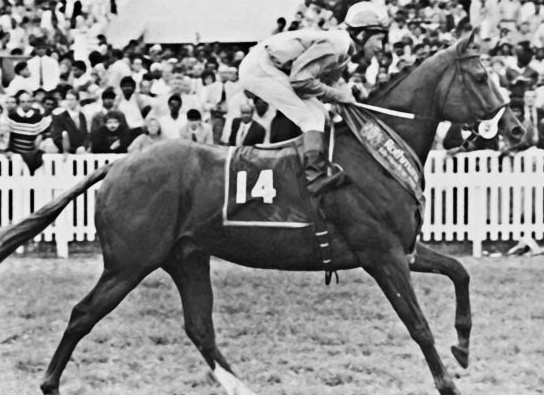
TEN BEST JULY WINNERS
7 ROYAL CHALICE (1988)
by Mark Anthony
Had Royal Chalice fulfilled his potential, he would probably have featured even higher on this list. Nevertheless, despite his curtailed racing career, he did enough to warrant attention as one of the most impressive of all July winners and he is one of the biggest names to have emerged from the all-conquering Terence Millard stable.
Beautifully bred and an absolute picture to look at, this handsome and charismatic chestnut was the best of a vintage crop of 3-year-olds. He can be judged by the quality of his peers: Jungle Warrior, the classiest of his rivals, as well as Priceless Asset, Coolstar, Castle Walk, Young England and Fearless Streaker all won at Group 1 level.
Royal Chalice was entitled to achieve great things on breeding alone. His father, British-bred Royal Prerogative, was one of the pre-eminent sires of his time, consistently finishing near the top of the SA stallion charts. His mother, Port Wine, did not have a great turf career but she was by that top broodmare sire, Plum Bold - an important ambassador for the Bold Ruler bloodline in South Africa.
Sent off a 14/1 outsider on his debut, Royal Chalice duly disposed of twelve rivals at Milnerton. Sent to KwaZulu Natal for the 1987 winter season, he won the Clairwood Nursery in eyecatching style but was then outpaced when third to Imperial Silver in the Smirnoff Plate [Gold Medallion]. His breeding suggested he needed more ground and this was proved to be the case when, upped to 1400m, he beat Sealegs by five lengths in the JG Hollis Plate. On the first day of his 3-year-old season he beat a high-class rival in Priceless Asset in the 1600m Summerveld Stakes to close off his winter campaign.
Back in Cape Town, he was narrowly beaten by top sprinter Wexford Boy over 1200m and then, after leading most of the way, scored a three-length win over highly-rated Young England in the Computaform Stakes back over a mile. Royal Chalice was now considered the champion 3-year-old elect because he had beaten nearly all the big-name rivals of his age group.
It was on Boxing Day, 1987, that Royal Chalice ran the race of his life, even though nobody realised it at the time. The race was the Queens Plate, the toughest test of his career to date. Bush Telegraph was sent off a hot favourite to regain the winning thread. Champion 3-year-old the previous season, he had won his first 9 starts, culminating in the Rothmans July. He had since suffered three defeats but his supporters hoped he would now be back at peak form. Royal Chalice was next in the betting at 5/2, his fans eager to see how he would shape up against the older horses at weight-for-age. Third-favourite was his 4-year-old stable companion Mark Anthony, another son of Royal Prerogative, who had won the Cape Derby the previous season.
Royal Chalice raced handily throughout and hit the front turning for home. His instant acceleration took him a few lengths clear and with Bush Telegraph and the rest of the field floundering, he looked set for a famous victory. But suddenly a massive bay brute loomed up the centre of the track. The orange colours of Mark Anthony swept past Royal Chalice as if the latter was standing still, and won by nearly two lengths.
In the immediate aftermath of the race, Royal Chalice`s fans were disappointed and it seemed yet another case of the Millard second-string upstaging the stable`s more fancied runner. A few weeks later, however, the enormity of Royal Chalice`s performance became clear. Mark Anthony demolished the J & B Met field, winning by seven lengths in record time, to stamp himself the best horse in the country. Suddenly, second place in the Queens Plate didn`t look too bad at all. In retrospect, it can be said that this was the finest run of Royal Chalice`s career, albeit in defeat: he was not yet fully matured and to get within two lengths of Mark Anthony at weight-for-age was a superb effort.
On the strength of this form, Royal Chalice was justifiably sent off a hot favourite for the 1988 Cape Guineas, even though the field assembled was a very strong one. Unfortunately, he was rushed up early to overcome his extreme outside draw and raced handily throughout. The race was run into a strong headwind and the effort took its toll: despite hitting the front early in the straight, he tired late and faded into fifth. Tactically, it was a mistake and considering his powerful turn of foot, it might have been better to keep him covered and come from behind - tactics which had successfully been employed by the first two, Young England and Jungle Warrior.
Durban and the winter season now beckoned. Sadly, Mark Anthony had been sidelined by injury, robbing SA racing of its newest superstar and biggest drawcard. Royal Chalice would be the flag-bearer for his stable.
After a comfortable warm up win over the Scottsville 1400m, Royal Chalice was sent off 9/10 favourite against a small but high class field in the SA Guineas. These odds looked too short as the field contained the likes of Jungle Warrior, brilliant winner of the Cape Derby and Sealegs, seven-length winner of the Dingaans. But the confidence proved justified as Royal Chalice, displaying an awesome turn of foot, powered home to win by nearly four lengths.
Next up was the Schweppes Challenge. Model Man, reigning champion older horse was returning from an injury-enforced layoff. However, at weight-for-age, he looked the one to beat and was sent off at 6/10. Sadly, he had not recovered from his setback and finished down the field. It was a case of a changing of the guard, and Royal Chalice signalled the dominance of the new order with a convincing two-length victory.
The brilliant 3-year-old had by now captured the imagination of the racing public and the big question on everyone`s lips was whether he would stay the 2200m of the Rothmans July, his next target. Certainly, there were serious doubts about his stamina. He had never ventured beyond 1600m and all his victories had been achieved in identical fashion: cruising in a handy position, hitting the front early in the straight and allowing his acceleration to do the rest. He looked very much a specialist miler and for this reason, was sent off at 6/1 on July day, behind favourites Pedometer and Model Man. The odds were a fair reflection of the conflict in the minds of the betting public: confidence in his sheer class but doubts over whether he would get the trip.
The field was fairly competitive and his key rivals were all guaranteed to stay. Model Man was the proven horse in the field but his fitness was under a cloud. The same applied to Tensing, the other Millard contender, a deadly front runner who was capable of winning this race with ease if his legs held up, but whose entire career had been interrupted by injury. Pedometer and Singing Boy, on the other hand were in good form, having run good July trials. Pedometer was famous for having won the 1987 version of the Summer Cup by an amazing 14 lengths and had then finished second in the same race in 1988 behind Singing Boy. Honey Bear had just come back to form winning the Greyville 1900, narrowly beating the consistent Gamlingsgay, who also looked a live contender. The real danger, however, looked to be Coolstar, winner of the SA Classic by 7 lengths and then an easy winner of the Daily News 2000.
Royal Chalice did not race as handily as usual, once the race got underway. He was tucked in a few lengths off the early pace which was disputed by the likes of Yardmaster, Coolstar, Pedometer and Tensing. The decisive moment seemed to come at the top of the straight when Pedometer was set alight and stole a 3-4 length lead. Pedometer looked to be going so well that victory looked a formality. But suddenly, Royal Chalice bolted through down the inside and in a matter of strides had settled the issue. He streaked away to win by 3,50 lengths, his devastating finishing burst leaving the opposition for dead. Gitano flew up late to snatch second from Pedometer.
For trainer Millard, it marked his fourth July win in six years, while jockey Felix Coetzee was recording his second win in the big race. Coetzee had, with hindsight, got his tactics wrong in the Cape Guineas and here he made handsome amends, giving the star colt a perfect ride.
Royal Chalice now looked to have the world at his feet, especially now his stamina doubts had been removed. Races like the J & B Met and Summer Cup would be well within his sights. Racing fans also hoped fervently that Mark Anthony would recover and return, as the thoughts of a now matured Royal Chalice taking on his stablemate was a mouth-watering prospect. It was a tantalising thought, but alas! one that was not destined to come to fruition.
Royal Chalice was duly voted Horse of the Year and returned to the Cape. Two preparation runs for the Queens Plate yielded easy victories in late 1988 and all looked well. The Queens Plate itself, however, turned out to be a nightmare: his fans watched in horror as he struggled, hard-ridden, to grab third place, well beaten behind Yardmaster. Something had clearly gone wrong and it was a huge disappointment when he missed the J & B Met. Given a five-month layoff to recover from his setback, he reappeared in May in the Drill Hall Stakes at Greyville, where it was hoped he had recovered in time to be a force for the 1989 winter season. Sadly, it was not to be. A one-paced fourth confirmed that he was no longer the same horse and he was retired to stud.
Royal Chalice`s departure was a cruel blow for his connections and for racing as a whole. Later that year came the sad news that Mark Anthony had died in training while attempting his comeback. Thus, the two greatest sons of Royal Prerogative never got to fulfil their potential.
Royal Chalice`s stud career was eagerly awaited, given his impressive bloodline and track performances. Almost inevitably, he could not live up to expectations: he got his share of winners, but nothing remotely as good as himself. It proved yet again that great racehorses don`t necessarily make great sires.
Despite his story ending in anti-climax, Royal Chalice deserves to be remembered as an outstanding racehorse who, at his best, could be compared favourably with the best milers ever seen in this country. His July victory was stunning and ranks as one of the best ever individual performances in the history of the race. In terms of breeding, looks, charisma and sheer ability, he was, in his prime, the complete package.
|