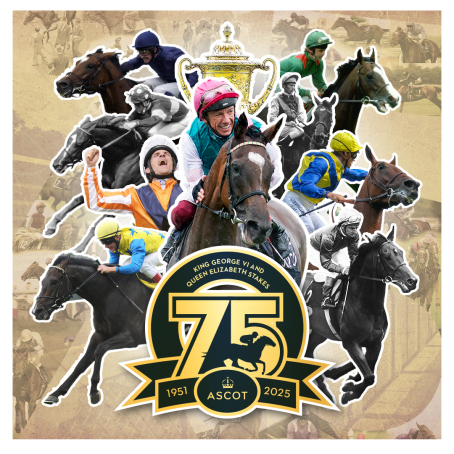
As Ascot prepares to stage the 75th King George VI and Queen Elizabeth Stakes, Britain’s premier all-aged Flat race has earned its place as one of the sport’s true crown jewels. A race that unites generations and often defines greatness, the King George has become more than a contest—it’s a chronicle of racing’s finest.
The race was born in 1951 with Supreme Court crowned the first champion. Three-year-olds dominated the early chapters—Tulyar in 1952 and Pinza in 1953, both fresh off Derby triumphs. But the 1954 winner, Aureole, brought a royal connection that lifted the race’s stature. Bred by King George VI and inherited by Queen Elizabeth II, the feisty colt overcame pre-race antics to storm home, bringing regal prestige to the event.
It didn’t take long for the race to attract international attention. In 1955, France’s Vimy took the prize, but it was 1956 that truly turned heads. Italy’s unbeaten superstar Ribot, bred by the legendary Federico Tesio, swept to a five-length win in his 14th straight victory—an unbeaten career capped with a second Arc that October.
The 1970s proved the King George’s golden age. The roll call is like a Hall of Fame induction: Nijinsky in 1970, effortlessly brilliant under Lester Piggott; Mill Reef, six lengths clear in 1971; the indomitable Brigadier Gerard grinding out a win in 1972; and Dahlia, the first dual winner, setting a track record in 1973 before repeating in 1974. The era reached its peak in 1975’s “Race of the Century,” where Grundy and Bustino slugged it out in a stretch duel for the ages. Grundy won, but all three—them and third-placed Dahlia—secured legendary status that day.
By the early 1980s, stars like Shergar added new shine. His four-length demolition in 1981 was his final racetrack appearance before his tragic disappearance. Later that decade, global powerhouse owners began leaving their mark. Dancing Brave rebounded from Derby disappointment with a 1986 win for Khalid Abdullah. Nashwan, for Shadwell, capped a brilliant 1989 campaign with a commanding performance.
The 1990s brought more brilliance. Lammtarra, just three starts into his career, won in 1995—like his sire Nijinsky, a Derby-King George hero. Swain became a two-time winner in 1997 and 1998, a feat only matched by Dahlia before and Enable later. Daylami took the 1999 edition, cementing Godolphin’s grip.
Into the 2000s, the balance of power tilted. Montjeu and Galileo—trained by Aidan O’Brien and representing Coolmore—ushered in a new dynasty. Their legacy extended with Hurricane Run, Dylan Thomas, and Duke Of Marmalade dominating between 2006 and 2008.
Then came the era of speed. Harbinger’s 2010 win not only dazzled with a 11-length margin but set a new track record, finally bettering Grundy’s 1975 time—on a new Ascot surface laid in 2005. But that didn’t last long. In 2013, Germany’s Novellist posted a time of 2:24.60, still the fastest ever seen.
Few horses have captured the public’s imagination like Enable. Her epic duel with Crystal Ocean in 2019 earned her a second King George. In 2020, she rewrote history by claiming her third, the only horse ever to do so.
As the race marks its 75th milestone, we look back just one year to Goliath’s dominant triumph. With Christophe Soumillon aboard, he surged clear in imperious style, saluting the crowd and etching his name into this great race’s legacy.
Each King George is a celebration of class, courage, and the passage of time. And as Ascot opens its gates for the 2025 edition, history is once again waiting to be made.
|