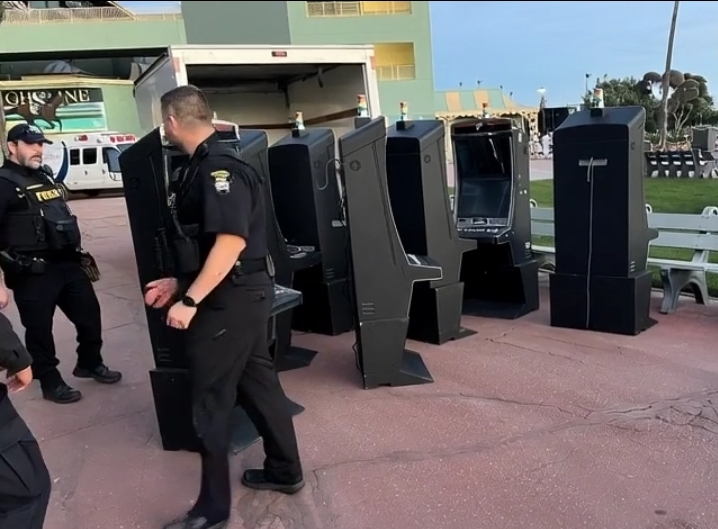
California racing found itself in another flashpoint over alternative wagering this week after state authorities removed newly installed “Racing On Demand” terminals from Santa Anita Park, just days after their quiet debut.
The machines—26 terminals placed on track property—were taken away Saturday afternoon by Department of Justice agents, less than 72 hours after being switched on without formal public announcement. Developed by PariMAX, a subsidiary of 1/ST Racing, the devices resemble slot machines but display horse races and are tied to previously run events. Wagers are pooled pari-mutuelly, with payouts determined by collective betting rather than fixed odds.
Before the shutdown, 1/ST Racing officials consistently maintained the games were legal under California law. Central to that argument is a wager known as “Three-by-Three,” a $1 exotic bet approved by the California Horse Racing Board in April 2024. While the wager itself received regulatory approval, it was not explicitly presented to the board as a product intended for use on historical races—a distinction that has now become critical to the legal debate.
Scott Daruty, senior vice president of 1/ST Racing, said the initiative was designed to help California racing remain viable in a national landscape where rival states benefit from alternative gaming revenue. California remains the only major Thoroughbred racing jurisdiction without supplemental gaming income to support purses, an issue long cited by industry leaders as a structural disadvantage.
Opposition to the machines was swift and expected. Tribal gaming interests, which operate casinos throughout the region, along with anti-gaming groups, raised concerns almost immediately. Those objections appear to have accelerated a law enforcement review, despite 1/ST Racing’s claim that the Attorney General’s office had been provided with a detailed legal analysis nearly a year earlier.
“We stand firmly behind our legal analysis,” Daruty said in a Saturday evening statement. “Racing On Demand operates under California’s longstanding pari-mutuel wagering laws using a wager that regulators already approved. Attorney General Bonta received our comprehensive legal analysis nearly a year ago. His office had ample time to raise concerns. They did not. We proceeded on solid legal ground, and since the state is choosing to challenge that now, we’re fully prepared to defend ourselves. We’re confident the law is clear.”
Whether that confidence holds up in court now becomes the central question. For California racing—already battling declining foal crops, shrinking fields, and rising costs—the outcome could shape how far innovation can stretch within existing law, or whether the state’s regulatory framework has finally reached its limit.
|