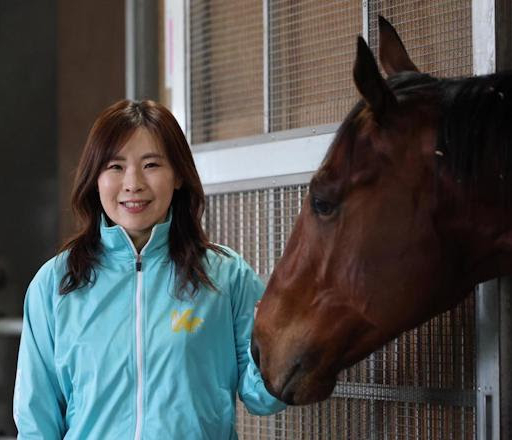
Twelve months can feel like a lifetime in racing. For Kyoko Maekawa, it has been a blur of firsts.
Last March, she became the first woman granted a training licence by the Japan Racing Association. Now, just a year later, she is preparing to saddle Sunrise Zipangu (JPN) in the world’s richest race, the G1 USD$20 million Saudi Cup at King Abdulaziz Racecourse on February 14.
Maekawa wasted little time making her presence felt. Formerly an assistant to dual Saudi Cup-winning trainer Yoshito Yahagi, she struck with her first winner as a licensed trainer when Sunrise Ares (JPN) scored at Kochi on March 18, carrying the same Life House Co. Ltd colours worn by Sunrise Zipangu.
The five-year-old has raced only twice since moving into Maekawa’s care. He was last seen finishing just two lengths off the winner in the Arima Kinen over 2500 meters on turf. The Saudi Cup will mark a significant shift: a drop back to 1800 meters, a switch to dirt, and his first appearance outside Japan.
“Sunrise Zipangu has mainly been racing on turf recently, but he has the speed to perform well on dirt,” Maekawa said. “I think that type of horse suits Saudi Arabia, and he also prefers racing anti-clockwise.”
Saudi Arabia is not unfamiliar territory for her. The Saudi Cup meeting was her first overseas racing experience while working with Yahagi two years ago, and it left a lasting impression.
“I was deeply impressed by the hospitality – there was nothing to complain about,” she said. “It is a wonderful country to be in, and it is a great honour to represent Japan at such an event.”
Maekawa’s path into the sport was anything but direct. She rode dressage horses at university before taking a part-time job at the Miho Training Centre, one of the JRA’s two main training hubs. That role opened the door to racing, but she waited nearly 15 years before attempting the notoriously demanding trainer’s exam.
“Training was always an option in my mind, but I didn’t take the trainer’s exam for nearly 15 years,” she explained.
A conversation in Newmarket helped tip the balance. Hanako Varian, wife of British trainer Roger Varian, offered simple advice: don’t overthink it.
“One of the barriers for me was the level of risk and responsibility trainers carry, especially toward their staff members,” Maekawa said.
Since taking out her licence, she has found support rather than resistance. Increased media attention, she notes, has been an unexpected benefit, effectively providing free exposure for her stable. Still, she is acutely aware that long-term success depends on attracting owners and quality horses.
“I must work hard on that, as I am not naturally a strong salesperson,” she admitted.
Her apprenticeship under Yahagi remains central to her approach. The experience took her to nine overseas trips across six countries, including Saudi Arabia, exposing her to elite international racing and bloodstock sales.
“It was a very full and meaningful time,” she said. “It was a precious experience for me to attend international race meetings and sales.”
She was particularly struck by Yahagi’s tactical flexibility, often deciding on targets late after detailed analysis of form and opposition. That philosophy has carried over into her own operation.
“I race my horses quite frequently – probably more than most rookie trainers – which is something I learned directly from Yahagi,” she said.
Should Sunrise Zipangu deliver on the Saudi Cup stage, it would be a landmark result on multiple levels: a breakthrough international success for a new trainer, a defining moment for Japan’s first licensed female conditioner, and a fitting reward for the owners who provided Maekawa with her first winner.
From Miho to Riyadh in little more than a year, Kyoko Maekawa’s story is already rewriting expectations—and the Saudi Cup now offers a chance to take that narrative onto racing’s biggest financial stage.
Image JRA
|