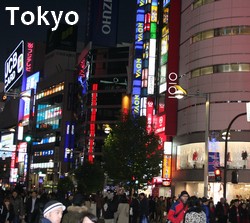
ASIAN RACING CONFERENCE IN TOKYO NEXT WEEK
The Eastern Hemisphere`s most important racing conference is due to be held
in Tokyo next week and SAHorseracing.COM is sending two representatives to cover
all the news coming out of the conference.
The Asian Racing Conference is a major event for racing nations outside of
the America`s and Europe. This important racing block controls some of the most profitable
racing regions in the world including Hong Kong, Japan and Korea.
The Asian Racing Conference was established in 1960 on the initiative of
Count Todamasa Sakai, President of the Japan Racing Association and Mr U Chit
Khine of the Rangoon Turf Club. It was renamed at the 28th Conference in 2001
and became the Asian Racing Federation.
As a result the first meeting of what has now come to be recognised as one of
the major international racing conferences in the world of thoroughbred
horseracing, took place in Tokyo in May 1960 when 69 delegates took part.
The founding member countries were Burma, Hong Kong, Japan, Malaya,
Philippines, Singapore and Thailand. India would have been included but a
delegation from that country was unavoidably unable to attend.
While Hong Kong is listed as a founding member of the Federation, local
racing in those days was conducted on an amateur basis and after the first two
Conferences a Hong Kong delegation was not represented again until the 10th
Conference in Melbourne in 1972 by which time a professional racing operation
had been set up in the colony, as it then was, and Hong Kong then became an
official member.
Since those early days the Federation has continued to expand, both in the
number of delegates attending and in the size of the geographical area covered.
At the 2nd Conference in 1961, Australia, India, New Zealand and Sarawak
became official members; at the 9th Conference (1970) Korea and Turkey joined;
at the 11th (1973) Indonesia and Pakistan; at the 16th (1982) Bahrain; at the
22nd (1991) Macau; at the 23rd (1993) South Africa; at the 24th (1995) the
United Arab Emirates; at the 25th Conference (1997) Mauritius; and at the 26th
Conference (1999) Saudi Arabia; and at the 27th Conference (2000) Oman; and at
the 28th Conference (2001)Qatar.
The objectives of the Federation have remained similar to those drawn up by
Count Sakai and Mr Khine. The objectives of the ARF are:
To meet and foster goodwill and mutual understanding through the medium of
periodic conferences and other racing events in the member countries. To promote
horseracing and breeding and the integrity and prestige thereof by any means
that the Federation shall consider appropriate and which are in compliance with
all existing laws, rules and regulations. To encourage and develop mutually
beneficial objectives and strategies between racing organisations without
discrimination to aid the development of horseracing. To exchange ideas and
information on matters connected with horseracing. To encourage, promote and
support international competition for jockeys and horses when conditions permit.
The Federation now meets approximately every 12 to 18 months.
A central Secretariat and an Executive Council was established in 1992. The
Secretariat is currently based in Australia and is staffed and funded courtesy
of the Australian Racing Board while the Council, which directs the work of the
Secretariat, is composed of representatives from Australia, Hong Kong, India,
Japan, New Zealand and the country appointed host for the next Conference.
Mr David Bourke, Chairman of the Victoria Racing Club, was Chairman of the
Council from its establishment in 1992 until 1997 when he handed over to Mr
Murray Acklin, President of New Zealand Racing Thoroughbred Inc.
In 2001 the ARF Charter was amended to establish two Vice-Chairman positions
on the Executive Council and Dr Imahara of the Japan Racing Association and Dr
Larry Wong of the Hong Kong Jockey Club were appointed to these posts.
In 2003 Dr Larry Wong was elected Chairman of the Council with Dr Naoki Koike
and Mr Robert Charley AO appointed as Vice Chairmen
In 2007 mr Winfried Engelbrecht-Bresges was elected Chairman of the Council
with Dr Isamu Takizawa and Dr Cyrus Poonawalla appointed as Vice-Chairmen.
The Executive Council meets approximately four times a year. The Chairman and
Vice-Chairmen of the ARF Executive Council sit on the Executive Committee of the
International Federation of Horse Racing Authorities. The ARF Secretary-General
also acts as a permanent technical advisor at meetings of the IFHA Executive
Council.
|




.jpg)