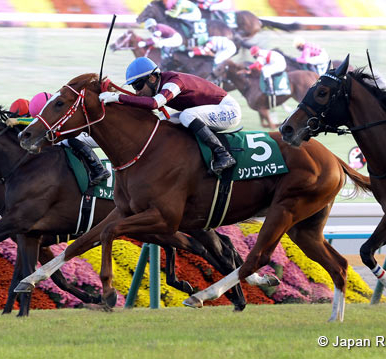
The 45th running of the Japan Cup on Sunday, Nov. 30, is shaping up as one of the most intriguing editions in years. Tokyo Racecourse, with its sweeping turns and unforgiving uphill stretch, will host 18 runners for the ¥500 million winner’s prize — a massive pot that has long made the race a magnet for elite global talent.
Once a truly international festival, the Japan Cup has recently seen foreign participation shrink to nearly nothing. This year continues the trend with only one overseas challenger — but he’s a heavyweight: Calandagan, fresh off being crowned Cartier Horse of the Year in London. Trained in France by Francis-Henri Graffard, the gelding arrives with a résumé that demands respect. He’s won three Group 1s this year, including the King George VI and Queen Elizabeth Stakes and the Champion Stakes, becoming just the second horse in history to sweep both in the same season. He also captured the Grand Prix de Saint-Cloud and hasn’t finished outside the top three in 13 career starts.
Calandagan flew into Narita on Nov. 20 after a 27-hour journey. His groom, Jeremy Lobel, reported that the horse stepped off the plane in excellent shape and settled into Tokyo Racecourse’s international stables without missing a beat. Should he manage to win, he’d become only the second France-based horse to take the Japan Cup — the first since Le Glorieux back in 1987.
The home team is anything but accommodating. Japanese racing brings depth, speed, and proven Tokyo specialists, including three Japanese Derby winners and seven Group 1 winners. Last year’s dead-heat runners-up, Shin Emperor and Durezza, return for another crack at the prize.
The spotlight, though, falls squarely on three Japanese headliners.
Masquerade Ball, a 3-year-old colt rated 121, enters off a career-defining victory in the Tenno Sho (Autumn). Christophe Lemaire timed the run perfectly, holding off Museum Mile over Tokyo’s long straight. While the colt’s best form has been at 1,800–2,000 meters, trainer Takahisa Tezuka believes the step up to 2,400 meters won’t trouble him — though he admits the quick turnaround between races is a concern. Recent history favors him: the past three Tenno Sho (Autumn) winners who attempted the Japan Cup all completed the double.
Croix du Nord, this year’s Japanese Derby winner, looms as a major threat. The striking son of Kitasan Black endured a tough trip in the Prix de l’Arc de Triomphe after an outside draw and heavy ground — both unfamiliar. Trainer Takashi Saito insists the effort wasn’t a question of ability. With clear weather forecast and firm ground expected, Croix du Nord returns to ideal conditions.
Then there’s Danon Decile, rated the strongest of the Japanese contingent. A surprise Derby winner in 2024, he delivered a breakthrough Group 1 performance earlier this year in Dubai, winning the Sheema Classic over 2,410 meters — and beating Calandagan by more than a length at equal weights. His flop in the International Stakes at York was widely excused due to a crushing 61-kg impost. Trainer Shogo Yasuda reports the colt has settled well after spending the summer in England and has returned home in great order.
Beyond the big names, several others remain dangerous. Tastiera, the 2023 Japanese Derby winner, rediscovered form in Hong Kong earlier this year but disappointed in the Tenno Sho (Autumn) after what his trainer called a tactical misjudgment. Durezza, second in last year’s Japan Cup, has run behind Calandagan twice overseas but returns fitter and sharper according to his stable. Justin Palace, Deep Monster, Admire Terra, and Shin Emperor each have the credentials to land in the frame.
Pace will likely come from three potential frontrunners: Shin Emperor, Sunrise Earth, and Ho O Biscuits. Only three horses in the race’s history — Katsuragi Ace, Tap Dance City, and Kitasan Black — have managed to steal the Japan Cup from the front. More often, the deep Tokyo stretch rewards tactical patience and late acceleration.
That long straight is where the race has traditionally tilted toward the favorite. Over the past decade, the market’s top pick has won six times and finished in the top three in nine of ten renewals. Whether that trend holds will be one of Sunday’s key storylines.
Post time remains 3:40 p.m., though the race shifts to the 12th and final on the card — a subtle change, but one expected to add to the day’s atmosphere.
The question that looms largest: Can Calandagan do what no European-based runner has done in nearly two decades?
He brings the class and consistency to make history. But beating Japan’s finest at Tokyo, over 2,400 meters, with the home team battle-tested and deep, is one of the toughest assignments in world racing. If Calandagan pulls it off, it will be a coup of rare magnitude — a true global championship performance.
|




.jpg)