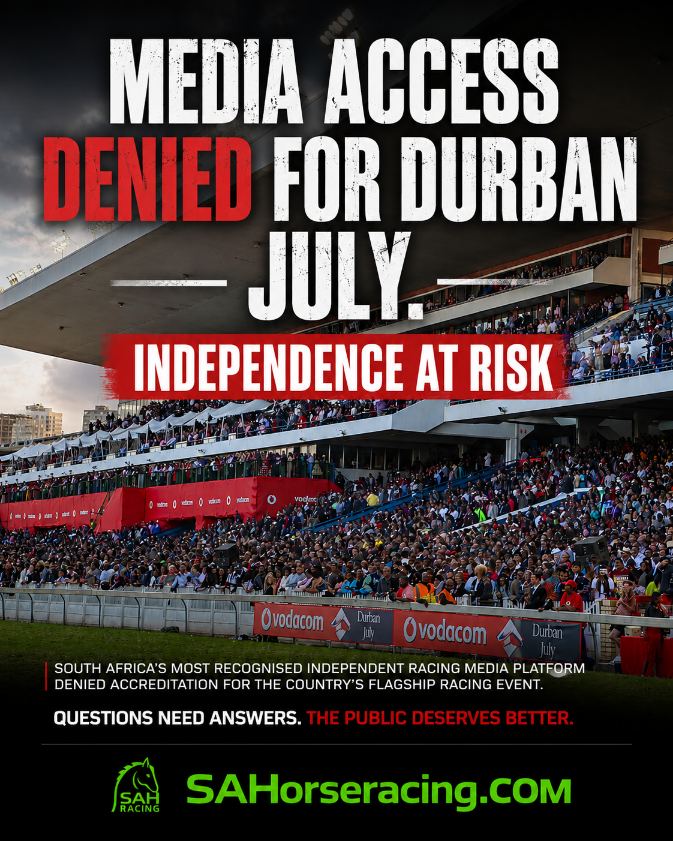
The decision to deny SAHorseracing.COM media accreditation for the 2026 Hollywoodbets Durban July is far more than an administrative decision. It raises uncomfortable questions about whether independent journalism is still welcome in South African racing.
For almost 25 years, SAHorseracing.COM has stood for one principle above all else—independence. It has never been owned by a racing operator, bookmaker, racing authority or commercial stakeholder. It has answered only to its readers and to the truth.
That independence has earned international recognition.
Since 2003, SAHorseracing.COM has attended more than 60 international racing events and conferences across 15 countries and over 30 racing cities. It has covered the world's premier meetings, including the Hong Kong International Races, the Saudi Cup, the Dubai World Cup, the QEII Cup in Hong Kong and Royal Ascot—all within the past six months alone.
In almost a quarter of a century, not one international racing jurisdiction has considered SAHorseracing.COM unworthy of accreditation.
Until now.
The irony is impossible to ignore.
While international racing authorities continue to recognise the value of independent South African journalism, South Africa's own flagship racing event has chosen to exclude it.
The rejection letter cites frequency of coverage, original editorial content, readership, industry recognition, commercial model and the number of accreditations allocated as reasons for declining the application.
Those are extraordinary assertions to level against the country's longest-standing independent racing publication—a publication that produces original editorial content throughout the year, reaches hundreds of thousands of readers across digital platforms and has become one of the world's leading and most recognised voices globally.
If those criteria are to be applied consistently, they should be transparent, objective and capable of independent verification. Accreditation decisions affecting media organisations should not depend upon subjective assessments that cannot readily be measured or scrutinised.
Media accreditation is not an award for favourable coverage. It is a mechanism intended to facilitate accurate reporting of matters that are in the public interest.
It comes only weeks after the Choisaanada controversy, where SAHorseracing.COM gave extensive coverage to what many participants regarded as an embarrassing and deeply damaging episode for South African racing. That reporting ensured the story reached audiences well beyond South Africa's borders.
It is therefore impossible to ignore the timing.
Is this merely coincidence?
Or has independent journalism become inconvenient?
These are fair questions because perception matters. When the country's leading independent racing publication is denied access while overseas media are reportedly invited and accommodated at considerable expense, legitimate questions inevitably arise.
Why invest significant resources in bringing international media to South Africa while denying accreditation to the country's most established independent racing publication? If the objective is to maximise exposure for South Africa's premier racing event, that decision appears fundamentally at odds with that goal.
By preventing on-course media access, the organisers inevitably reduce the quantity and quality of independent coverage available before, during and after the event. Race-day reporting, exclusive interviews, behind-the-scenes features, photography and real-time digital engagement are all diminished.
At a time when South African racing is confronting declining attendances, reduced public interest and increasing competition for attention, the last objective should be to reduce media exposure of its flagship event.
If the Durban July is to grow its audience, attract new followers and strengthen its international standing, it requires more credible media coverage—not less.
This decision therefore raises an obvious question: How does limiting independent on-site reporting help grow the race or the sport?
Far from strengthening the event, it risks becoming an unnecessary own goal for an industry already facing significant commercial, financial and reputational challenges.
Even more concerning is that many media organisations covering the event are directly or indirectly associated with industry stakeholders. Independent journalism exists precisely because it is free from those relationships.
No sporting code benefits when criticism is discouraged or independent voices are marginalised.
Media accreditation should never become a mechanism that creates the perception of rewarding favourable coverage while excluding those prepared to ask difficult questions.
SAHorseracing.COM will continue to report on South African racing with the same independence and integrity that have defined its work for nearly 25 years.
But this decision deserves a transparent explanation, because this is no longer simply about one publication.
It is about the principles that govern media access, the credibility of the accreditation process, and whether South African racing welcomes independent scrutiny as an essential part of a healthy, accountable and progressive sporting industry. Make no mistake, the loss is on the part of horseracing in South Africa more than for SAHorseracing.COM as this organisation has one of the strongest local and global audiences available in the sport.
Independent journalism is rarely comfortable. It is not intended to be. Its purpose is not to protect institutions, but to inform the public.
|




.jpg)